
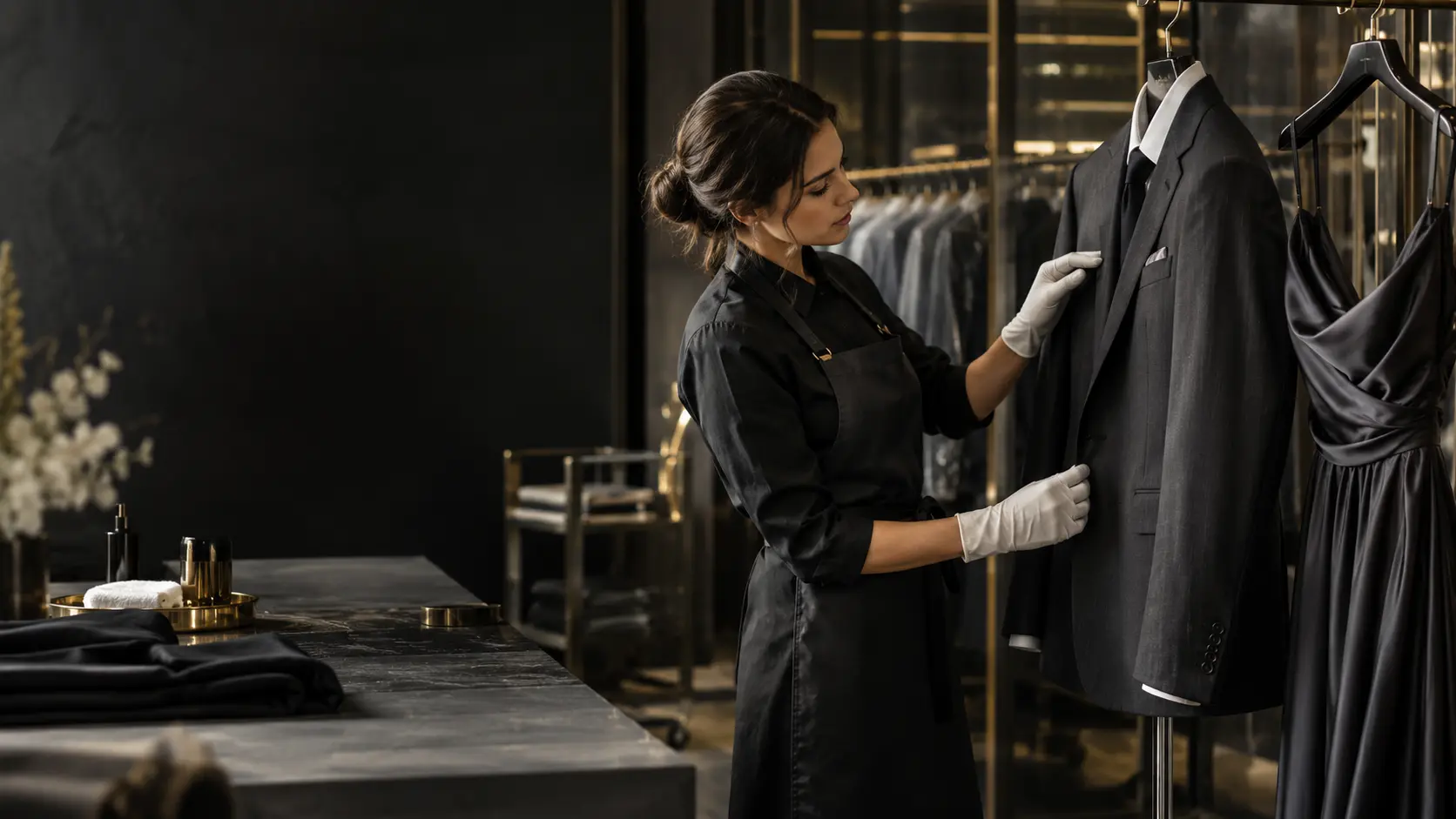
Read the entire care label before choosing a method
Begin with the permanent care label and follow every instruction for washing, bleaching, drying, ironing and professional cleaning. The Federal Trade Commission's Care Labeling Rule requires a supported regular-care method and necessary warnings for covered apparel. A washing instruction should identify hand or machine washing and a safe water temperature; dry-cleaning instructions may also restrict solvent, moisture, heat or steam.
Do not use the fiber-content label as a substitute for care instructions. Two garments marked 100% silk may have different dyes, finishes and construction. A silk shell can also include a different lining, fusible interfacing, elastic, padding, beads, sequins, leather, metallic thread or printed decoration. If the label is missing, unreadable or inconsistent with the garment, separate it from routine laundry and request an item-specific professional evaluation.
Wash silk only when the label permits it
If the label allows hand washing, use the stated temperature and method exactly. Support the garment throughout the process and keep handling gentle. Avoid rubbing, twisting, wringing or leaving it to soak unless the manufacturer specifically permits that step. Use only a detergent and dosage compatible with the label; a product described as gentle is not automatically appropriate for every silk dye or finish.
If the label permits machine washing, follow its cycle, temperature and load instructions. A mesh bag can reduce contact with fasteners and rough fabrics when the garment manufacturer allows machine care, but it does not make an unsupported method safe. Wash compatible colors and materials together, and do not add chlorine bleach. Canadian Conservation Institute guidance notes that silk is a protein fiber that can be damaged by strong alkalis and chlorine.
Need help with your garments locally?
See how we review care labels, fabric, construction, trim, visible stains and garment condition before recommending care. Professional dry cleaning is available through our North Houston stores.
For everyday dry cleaning and laundry, free pickup and delivery runs on Tuesdays and Fridays in The Woodlands and select nearby neighborhoods. Normal cleaning charges apply; no membership is required. Tell our team about stains and any treatment already attempted.
Check pickup availabilityChoose professional dry cleaning when the garment calls for it
Use professional care when the label says dry clean or dry clean only, and when structure, decoration or color makes water care uncertain. Lined dresses, tailored silk jackets, ties, crisp pleats, bias-cut garments and pieces with beads or multiple materials may depend on more than the silk face fabric. A cleaner should inspect the complete item before selecting a process.
Bring matching or detachable pieces when their instructions indicate they should be cleaned together. Point out every stain and disclose water, heat or products already applied. Professional cleaning cannot guarantee that every old mark will disappear without risk to color, texture or finish, but an inspection helps balance stain treatment against the garment's construction and current condition.
Blot spills and avoid home stain experiments
Blot fresh liquid gently with a clean, absorbent white cloth. Lift loose material with a dull edge without pressing it into the weave. Do not rub the fabric together. Avoid club soda, salt, bleach, enzyme products, ammonia, alcohol, dish soap, stain pens and homemade mixtures unless the garment manufacturer specifically approves them for that item.
The Smithsonian Museum Conservation Institute's stain-removal guidance explains that silk can be damaged by chlorine bleach, protein enzymes and alkali, and that silk becomes more vulnerable to stretching or tearing when wet. This is a reason to stay conservative, not a universal instruction to avoid water: a washable garment should still be cared for according to its label. Identify the spill and arrange evaluation promptly when the treatment is uncertain.
Support wet silk and keep it away from direct heat
When a label permits washing, lift the garment with both hands or another clean support so its wet weight does not pull on seams, straps or bias-cut areas. Do not wring it. Follow the label's drying instructions, reshape only as directed and use a clean drying surface or suitable hanger when permitted. Keep wet silk away from radiators, hair dryers and tumble drying unless the label expressly authorizes heat.
Dry the garment away from direct sunlight. The Canadian Conservation Institute notes that silk is particularly sensitive to light and that light damage can weaken fibers and alter color. If dye transfers, the garment develops a tide line, seams distort or the texture changes, stop adding moisture or heat and seek professional advice.
Press wrinkles only within the label's limits
Check the ironing symbol and any temperature or steam warning before applying an iron or steamer. Do not test a product or technique on a visible area. When the label permits ironing, use the lowest approved setting, work carefully and avoid holding heat in one place. A clean pressing cloth can add separation when the garment instructions support it, but it cannot protect silk from excessive temperature or an unsafe treatment.
Water droplets and uneven steam can leave marks on some silk fabrics, while excessive pressure may flatten texture or leave shine. Pleats, velvet surfaces, metallic finishes, delicate prints and embellished areas require particular caution. If a clean silk garment needs a polished finish but its pressing instructions are unclear, professional finishing is safer than escalating heat at home.
Air between wears and clean before storage
A silk garment does not automatically need full cleaning after a short wear, but perspiration, cosmetics, perfume, food and body oils should not remain indefinitely. Air the item indoors away from direct sun before returning it to the closet. Avoid spraying fragrance or deodorizer onto the fabric. Clean according to the label before long-term storage, and confirm that the garment is fully dry.
Store silk in a clean, cool, dry and dark interior space. The Canadian Conservation Institute's textile-care guidance recommends avoiding ordinary wire hangers and long-term plastic garment bags. A stable garment in good condition may use a broad, padded hanger with room around it, while a fragile, knitted, bias-cut or heavily decorated piece may be safer stored flat with appropriate support.
Know when item-specific evaluation matters
Request professional evaluation for dry-clean-only silk, missing labels, unstable color, difficult stains, water rings, vintage pieces, damaged seams, weak fabric, beads, metallic trim, velvet, heavy decoration or mixed-material construction. Age and prior treatments also matter. A method that worked for one silk scarf should not be assumed safe for a different blouse or dress.
Bring uncertain items to a Comet Cleaners North Houston location and explain what happened before the garment is processed. Our dry-cleaning service page describes the inspection, cleaning and professional-finishing process. The care label remains the starting point, and evaluation of the actual item is the right next step when its materials or condition make general advice incomplete.